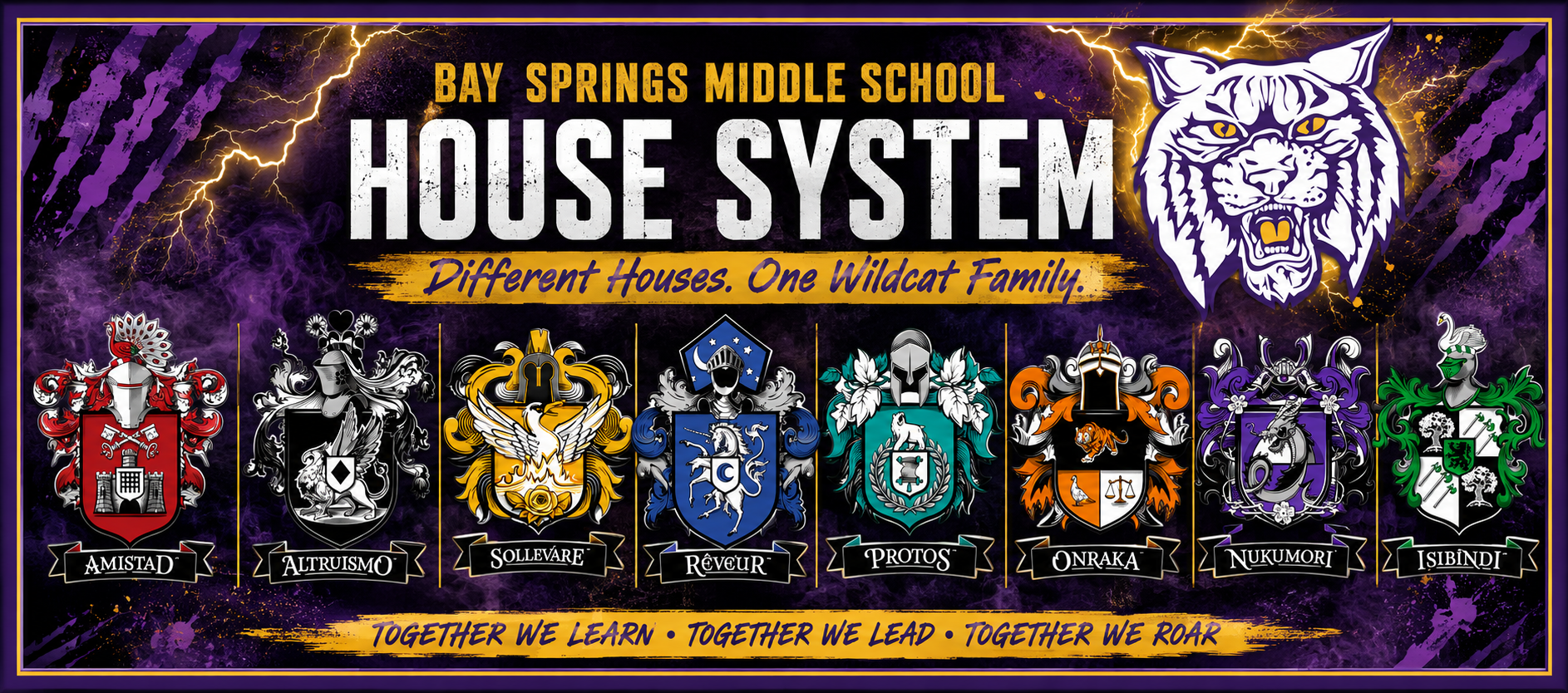
image showing all 8 bsms house logos

Monthly House Challenges

Get ready to show your House pride! Each month, Bay Springs Middle School students will have a new House Challenge designed to bring us together, have fun, and earn points for your House.

Whether you’re competing with creativity, school spirit, knowledge, teamwork, or kindness, every student can make a difference! Jump in, participate, and help your House climb to the top!

Your House. Your Challenge. Your Chance to make a difference! πŸΎπŸ†

Sock-tober House Challenge Bring in a new pair of socks for our local homeless shelter.  Socks Donated to Fullerville Mission.  Sponsored by BSMS Jr Beta CLub
image of house challenge to get a library card
8 HOUSES, 1 WILDCAT FAMILY We are excited to announce that Bay Springs Middle School is implementing the Ron Clark Academy (RCA) house system. This house system creates a community and provides a sense of belonging among our students while encouraging student leadership and motivation to succeed in school. Each student is assigned into 1 of 8 houses listed below and will have the opportunity to participate in house-specific events and activities throughout the year. Students stay in the same house throughout their educational career at Bay Springs. This sense of belonging can help students feel more connected to their school and peers, which leads to greater engagement and motivation in their studies. The House of Altruismo Altruismo traces its origins to the rainforests of the Amazon, where a group of powerful Brazilians were given the name because of the Portuguese meaning behind it: “the Givers.” The House of Amistad Amistad is the House that originates from Mexico. A group of kind but powerful individuals that are known most for their unconquered spirit. They are the protectors of the realm and everyone's best friend. This is why, in the language of their ancestry, their name means “friendship.” The House of Isibindi Isibindi is a tight-knit group of individuals, like a pride of African lions, where family means everything. The House’s symbolic animals, the mute swan and the lion, serve to empower incoming members. While new students might be quiet or shy at first, the longer that they are in the House, the more they begin to display the characteristics of strength and bravery. In Zulu, Isibindi means “courage.” The House of Nukumori Nukumori is the House that originates from Japan. A group of individuals that understand that kindness is the true strength that will build their character, the members of the House of Nukumori are known for the friendship that they extend to everyone around them. They treat others with respect, and in doing so they earn the respect of all others.
The House of Onraka Onraka traces its origins to the land beyond the Himalayan mountains, where a group of powerful Indians were given the name because of the Tamil meaning behind it: the House of Unity. The House of Protos Protos is an ancient House of wisdom whose name reflects the Greek root word meaning “first” — the House whose destiny is defined by striving for excellence. The House of Rêveur Rêveur is a royal House whose name in French means “dreamers” or “idealists” — because the members who fill this group are students filled with freedom and wild abandon who recognize their dreams and will let nothing stand in the way of achieving them. This can be seen in the unicorn, which is on the center of the House’s crest, a powerful creature who is almost impossible to tame. Similarly, the House of Rêveur is a House of passion. The House of Sollevare Sollevare is the House that originates from Italy. It was formed by a group who understood that the true strength of being undefeated warriors lies in always getting back up, no matter how many times they may be knocked down. The members of the House of Sollevare are known for their uplifting nature — always rising above, and helping others do the same. This is where their name comes from in Latin, meaning to “lift” up.  Student Leadership and Benefits of the House System Students can take on leadership roles within their houses, such as serving as house leaders or leading house events. These roles help students develop important leadership skills and build self-confidence. The RCA house system has also effectively improved academic performance when implemented correctly. Schools worldwide that have implemented the system have seen a decrease in discipline referrals, improvements in relationships among peers and staff, and increases in academic performance. These benefits come from how the system encourages students to take ownership of their learning and behavior while working together to achieve common goals with their peers. We are pleased the RCA house system is a valuable addition to our school community, and eagerly anticipate the ongoing positive impact it will have on our students. Again, thank you for your support.